

The Cost of Doing Nothing
The Cost of Doing Nothing
Not investing in Leadership Development has a real cost. It might not be visible immediately, but it'll creep up on the business slowly and undoing years of poor leadership behaviour is much more of a challenging than investing in it today. Let's tot up a few stats and see what that cost of doing nothing actually looks like.
It doesn't show up as one clean number, but shows up in:
- Employee attrition (clear red flag)
- Recruitment costs (clear red flag)
- Increased sickness (clear red flag)
- Low engagement scores (clear red flag)
- Overtime to cover lower productivity (subtle flag)
- Lack of innovation (subtle flag)
- Lack of challenge or feedback culture (subtle flag)
- Untapped performance (sometimes invisible to see what could be achieved with better leadership)
There’s lots to consider, so let’s look at some statistics from trusted sources and you can start to tell a story that’s quite compelling.
The Global Cost of Low Engagement
Gallup's 2026 State of the Global Workplace puts the global cost of low engagement at $10 trillion in lost productivity, 9% of global GDP. Engagement itself fell to 20%, its lowest level since 2020, with 17% of employees now actively disengaged. A big number to start, but hard to relate to.
UK Engagement Trends
Culture Amp's latest UK benchmark data (July 2025 to June 2026) puts engagement at 65%, though that leaves the UK in the bottom 38% of the countries it tracks. On retention, 24% of UK employees are currently thinking about or actively looking for another job and 14% expect to have left within two years.
The Cost of Brain Drain
Oxford Economics' "Cost of Brain Drain" study puts the average cost of replacing an employee earning £25,000 or more at £30,614, once you count recruitment, lost productivity during the gap, and the time it takes a replacement to reach full output. That figure climbs with seniority and sector, and rises further at larger companies. Now that study is from 2014, so rather than quote that figure as if it were current, we've used it as a ratio instead, roughly 1.2 times annual salary, and applied that to today's numbers throughout this blog. It's still one of the few public studies that breaks down what a departure costs beyond the recruitment fee alone, which is why it's a strong reference, even a decade or so on.
Why engagement has gone down
Gallup's own figures point to a clear explanation, and it starts with managers, not individual contributors. Manager engagement fell from 31% in 2022 to 22% in 2025, a far sharper drop than IC’s, who've stayed close to 18-20% over the same period.
Since managers account for roughly 70% of the variance in how engaged their own teams feel, a manager who's checked out doesn't just cost their own productivity, it drags a whole team down with them.
Behind that sits restructuring. A lot of companies cut management layers over the past few years, leaving the managers who remain covering more people with less support. Sprinkle a layer of AI anxiety on top and you can see how this trend is only going in one direction.
Fewer employees now say their manager encourages their development too, 30%, down from 36% in 2020, and only 39% feel their employer genuinely cares about them. Both of those are levers a leadership programme moves directly.
Preaching to the choir here we know, but your stakeholders are probably not as up on the stats so let’s turn this into a business case conversation you can use.
What this looks like for SaaS businesses
Let’s say you’re a SaaS company with 1,000 employees and £100m in annual revenue, a similar profile to a number of our clients. Here's how those stats translate into a number specific to that sort of business, using assumptions you can swap for your own.
Calculations:
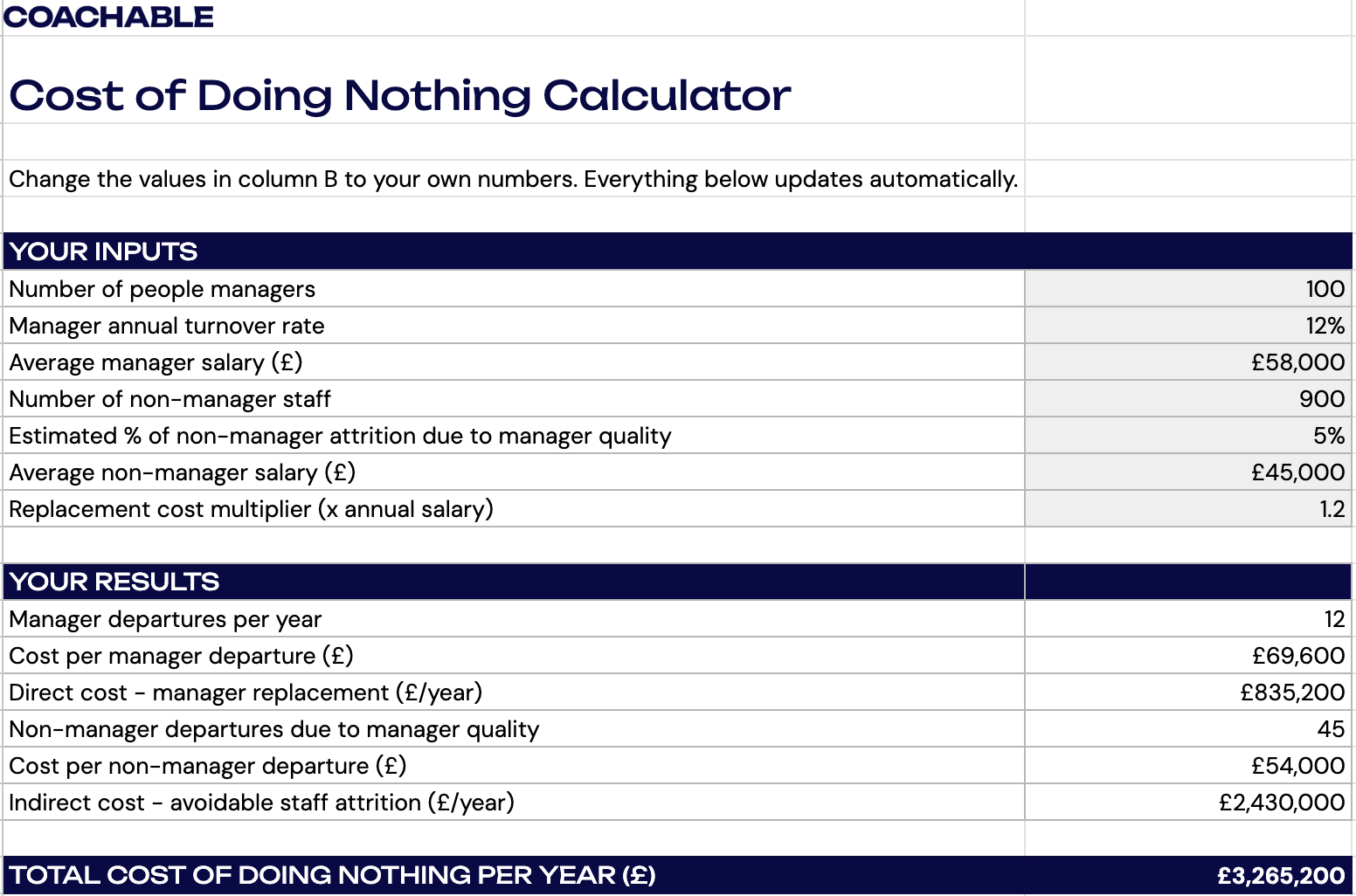
No. of Managers: Average span of control of one manager to every ten employees, that's around 100 people managers across the business.
Manager turnover: a conservative 12% annually, lower than average staff turnover equates to 12 people leaving a year.
Cost per departure: Oxford Economics found replacement costs run to around 1.2 times annual salary once recruitment, cover, and ramp-up time are counted. At an average UK SaaS manager salary of £58,000, that's roughly £70,000 per departure.
12 managers x £70,000 = £840,000 a year, in manager replacement costs alone, before counting anything else.
That’s the direct cost of doing nothing. Mic drop moment so that number really lands.
The cost of doing nothing for an average 1,000 Saas company is £840,000 a year on direct manager replacement costs.
The indirect cost sits with the roughly 900 staff those 100 managers lead day to day. Given Gallup's finding that managers drive 70% of engagement variance, a share of a team's disengagement, and eventual attrition, traces back to how well their manager was equipped to lead them.
A conservative estimate, that 5% of those 900 staff leave specifically because of manager quality rather than any other reason, adds 45 more departures a year. At an average non-manager replacement salary cost of around £45,000, that's a further £2,430,000.
Put those two lines together and a business this size is looking at just over £3.3m a year in costs that a leadership development programme is built to reduce.
Do the Maths For Your Business
We've created a calculator you can copy and use for your own business. Just input the numbers that relate to your company and it'll automatically calculate your cost of doing nothing. Ta da! Or if you'd rather use your own spreadsheet:
- Number of managers x manager turnover rate x (average manager salary x 1.2) = direct replacement cost
- Number of non-manager staff x estimated share leaving due to manager quality x (average staff salary x 1.2) = indirect cost
Swap in your own headcount, salaries, and turnover rate, and you'll have a number specific to your business rather than a global statistic to explain away.
Want your leaders to step up? Invest in them.
Organisations that proactively invest in leadership consistently outperform their peers. A 2024 HR Magazine report found that companies treating leadership development and engagement as strategic priorities are 52% more likely to hit key performance outcomes.
Where to start
Getting leadership development on the exec agenda isn’t always easy. Here are a few ways to move the conversation from "nice to have" to "non-negotiable":
Speak their language:
Lead with outcomes, not activities. “Here’s how we improve performance at scale.” sounds a lot better than “We think we should run a leadership programme”.
Frame it as risk, not just reward:
Benefits and upsides are in the future, but risks are already showing today. Building a case around the cost of doing nothing is something everyone can relate to. Think turnover, decision bottlenecks, toxic cultures, or lost innovation. Risk mitigation is just as important as reward.
Use internal data:
Pulse surveys, engagement scores, exit interviews are all your friends here. Connect the dots between what’s broken and how leadership development helps fix it.
Find an exec ally:
You only need one. The right champion with the right influence can open doors (and budgets). Start small, show impact and let the work speak for itself.
Prioritise or start small:
If you’re struggling to get buy-in for a full roll out of leadership development, focus your efforts on one population that’s going to have the biggest impact and then use those results to influence a broader roll out
Need help?
Building your case for budget for L&D? Talk to us, we're happy to help you find the numbers and right approach to development that will land with your specific stakeholders.
Check out our blog on using the POWER model to build a business case for L&D


.jpg)


