

The Blog

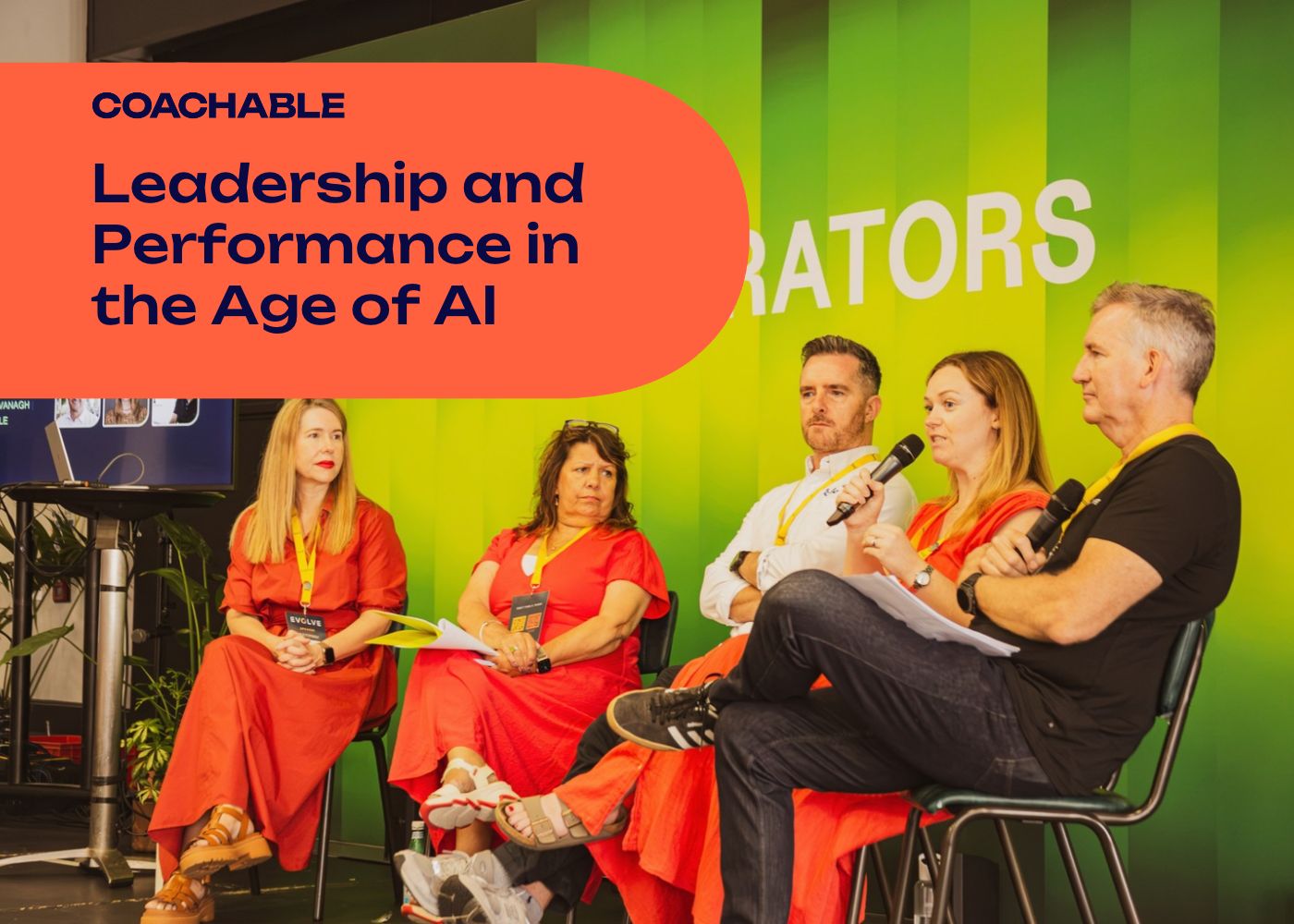
In June, we joined 5,000 others at EVOLVE [26], a tech conference hosted by Silicon Brighton at the Brighton Centre. Ally Jones, one of Coachable's co-founders, joined moderator and Organisational Neuroscientist Soraya Shaw and her fellow panellists for a conversation on the role of leadership in the age of AI, and its impact on organisational performance.
Alongside Soraya Shaw, Ally Jones was joined by:
If you want the details, keep reading, or watch the full panel here:
Soraya opened the session with a comparison worth reflecting on: that the industrial revolution changed how we worked, yet AI is changing how we think, which makes it a different kind of disruption entirely, and a much harder one to manage by instinct.
Every panellist agreed something significant was underway but the disparity of opinions below that headline was interesting. Simon Pringle described the current moment in his own business as "a tumble dryer," everyone tumbling around trying to work out what's actually happening. David Kavanagh called it "the messy middle." Both were describing the same gap: most organisations have an opinion on AI, but little has been set in stone.
Ally’s view was more specific. The biggest gap she sees with Coachable's clients isn't technical capability, it's the absence of a clear line between what AI is being used for and what is being deliberately kept human.
A pattern we see at Coachable repeatedly with clients is that the exec team is rarely the one running AI change day to day. That job instead lands with the layer below, exec-1, who are often expected to lead a transformation they didn't design and aren’t necessarily equipped to lead.
The consequence isn't just fairness, it's effectiveness. A leader who has been told what to do without being told why can pass on an instruction, but not conviction. When the situation shifts, and keeps shifting, instructions without conviction don't hold. Ally's advice to leaders in that position was direct: leaders must have the courage to manage upwards, and ask the same questions your own team would ask you. What options were considered? What evidence shaped the decision? Why this call, and not another one?
David candidly shared that about a year ago, he'd separated his engineers into two camps: those who love the craft of writing code, and "builders" more focused on outcomes. He now thinks that framing was wrong. The more useful lens, he said, is a rainbow, people at genuinely different points in the journey, and leadership's job is to cross-pollinate across it rather than sort people into camps. Sophie's read on the same dynamic came from a different angle: the change curve inside teams has always existed, but AI has widened it, with early adopters racing ahead of colleagues who need more time, and leaders having to hold both ends without dropping either.
Ally was asked what the leaders getting this right are doing differently, and her answer came back to communication, specifically the difference between being transparent about a decision and simply announcing one. The leaders she rates highly are the ones creating space for people to say, openly, that they're worried about their job, their relevance, or their sense of expertise, without treating that as a problem to be managed away.
David's version of this was a sutble warning: somewhere in the pile of AI commentary he'd read was a line from an engineer who said he wasn't anti-AI, he was against the way his own company was pushing it. That's the risk of not naming the elephant in the room. People leave but without a big fanfare or axe to grind. They just stop buying into the way things are done. Simon's business has taken the more structural route, building an AI steering group so decisions about adoption are made with the team rather than announced to it, on the logic that people who own part of a change stop being afraid of it. He was candid that this is exhausting to sustain, and a harder sell to customers than to his own staff, because sometimes what gets automated is visibly someone's job.
Asked how leaders actually build resilience, rather than just talk about it, Ally didn't reach for a framework. She said, plainly, that people are tired. Coachable has worked with around 600 leaders over the past couple of months, and the proportion describing themselves as close to burnout is, in her words, genuinely worrying.
Her point was that this is a genuine capacity challenge, and it needs to be treated as one, organisationally as much as individually. Two specifics from her answer are worth holding onto. First, most of us are far better at offering help than asking for it, and building a resilient team means being honest that nobody has to be operating at full capacity all the time, as long as someone else on the team can absorb the gap. Second, and more uncomfortable for leaders specifically: the instinct to shield your team from difficulty, to put on what Ally called "the superhero cape," can look like support while quietly taking away someone's ability to work out what they actually need. Sometimes the most useful thing a leader can do is not fix it.
The last thread running through the panel was permission, specifically, permission to get things wrong without it becoming a catastrophe. Ally's framing was that psychological safety has to be role-modelled, not policy-announced: leaders need to make it genuinely acceptable to experiment, and to fail at that experiment, inside guardrails that stop a mistake from ever reaching a customer.
David gave the most concrete example of what that looks like in practice. Tillo runs a recurring session that started life eighteen months ago as "engineering AI community day," The word “AI” was quickly dropped in recognition that AI is simply part of how work is now done. The session exists purely to let people step out of their day-to-day workflow and experiment cross-functionally on real problems, with no delivery pressure attached. That's a sandbox in the literal sense, and it's a large part of why his team was able to move as fast as it has.
Closing the session, each panellist was asked for a single thought to leave the room with. Sophie's was to keep leaning into the pace of change rather than resisting it. David's was that the goal now isn't speed for its own sake, it's bringing the whole organisation along together, and holding onto human values like creativity and systems thinking while doing it. Simon's view was that whatever people are telling you isn't ready yet, it's here, it's now, and waiting for permission is its own kind of risk.
Ally's closing point was the one she'd opened with, restated: be deliberate. Decide what AI is for. Decide, just as deliberately, what stays human. That decision is a leadership responsibility, not a technical setting, and it's the one thing on this list that no tool will make for you.
Ally Jones is a co-founder of Coachable, a UK-based leadership development consultancy where every coach, including the founders, is a fully qualified executive coach. Coachable runs bespoke leadership development programmes and executive coaching for tech and scale-up leaders, including clients like OutSystems, Tribal Group and OVO. Thanks to Silicon Brighton for having us, and to Soraya, Sophie, David and Simon for an enjoyable and candid conversation.


Multi-award winning coach, facilitator and learning experience designer.
Multi-award winning coach, facilitator and learning experience designer.

Copyright Coachable Partners Limited. 128 City Road, London, EC1V 2NX


.png)
