National Mentoring Day: How to be an Effective Mentor
National Mentoring Day: 27 October 2026
Ask anyone about the people who shaped their career, and a mentor usually comes up. Someone who backed them before they were ready, asked the question nobody else would, or opened a door they didn’t know was there.
A long-running study at Sun Microsystems found employees with mentors were promoted five times more often than those without, and 72% of mentees stayed with the company, compared with 49% of people who weren’t part of the programme. A CNBC and SurveyMonkey survey found 91% of workers with a mentor are satisfied in their jobs. In other words, mentoring for the win!
So for National Mentoring Day, we asked our community of HR, L&D and People leaders what makes mentoring work. Their answers were generous, honest and full of things you can use straight away, so we'd love to share our key take aways from their advice:
01. Great mentors get curious before they give advice
The strongest theme in the tips for mentors was restraint. When someone comes to you for help, it can be tempting to jump straight to what worked for you. Our community was clear that the best mentors hold back and find out what the other person needs first:
Anabela Barbosa, Head of Talent Development at Feedzai: It's tempting to share what worked for us, but their ambitions, challenges and circumstances might be completely different
Andreea Constantin, Senior Leadership & Talent Consultant, Dante International: Usually, mentors are expected to give their perspective and great advice, but what I find is really useful is for mentors to truly understand what mentees are going through or what their challenge is. Good mentors ask powerful questions
Rizwana Mujeeb, Head of Human Resources, IFFCO: Be curious before you give any advice. The right question can be more powerful than the perfect answer.
And Meg Burton, a leadership coach described the balance as knowing "when it's good to share your insight, wisdom, experience and guidance, and when it's good to coach."
Our Advice? Be clear about your expectations for mentors; what behaviours do you expect from them? What makes a great mentor in the context of your organisation? And don't forget to invest in the skills that really matter: curiosity, asking powerful questions and creating a listening environment. In many ways, the things that can make you an exceptional coach, are increasingly transferable to those that'll make you an exceptional mentor too.
02. Great mentees come prepared!
Whilst many mentoring programmes focus on ensuring mentors have the right training and support, with the mentee responsible for the mentoring relationship, don't forget to prioritise time in ensuring they have what they need to succeed too. Here are a few of the best tips for those of you wanting to get more out of being a mentee:
Hakan Polat, Managing Director, iDoctor: Come with a problem, not a question. A question gets you an answer. A problem gets you a conversation.
Louise Gutteridge, Head of People and Culture, Barker Langham: Keep notes and refer back to them. Before each session, review what you committed to last time and bring one or two focused topics. During it, jot down the insights and actions that matter. Afterwards, take five minutes to reflect and set next steps. Your notes become a record of your progress, and they show your mentor you value their time.
Jo Ionescu, Senior Experience Designer: Come prepared with a specific challenge, but stay open to where the conversation takes you. I think mentoring is most valuable when you're honest about what you don't know, willing to hear a different perspective, and ready to put the advice into practice. After the conversation, take a moment to reflect on what you learned and identify one thing you can actually do differently. A good conversation can inspire you, but applying what you learned is what makes the difference.
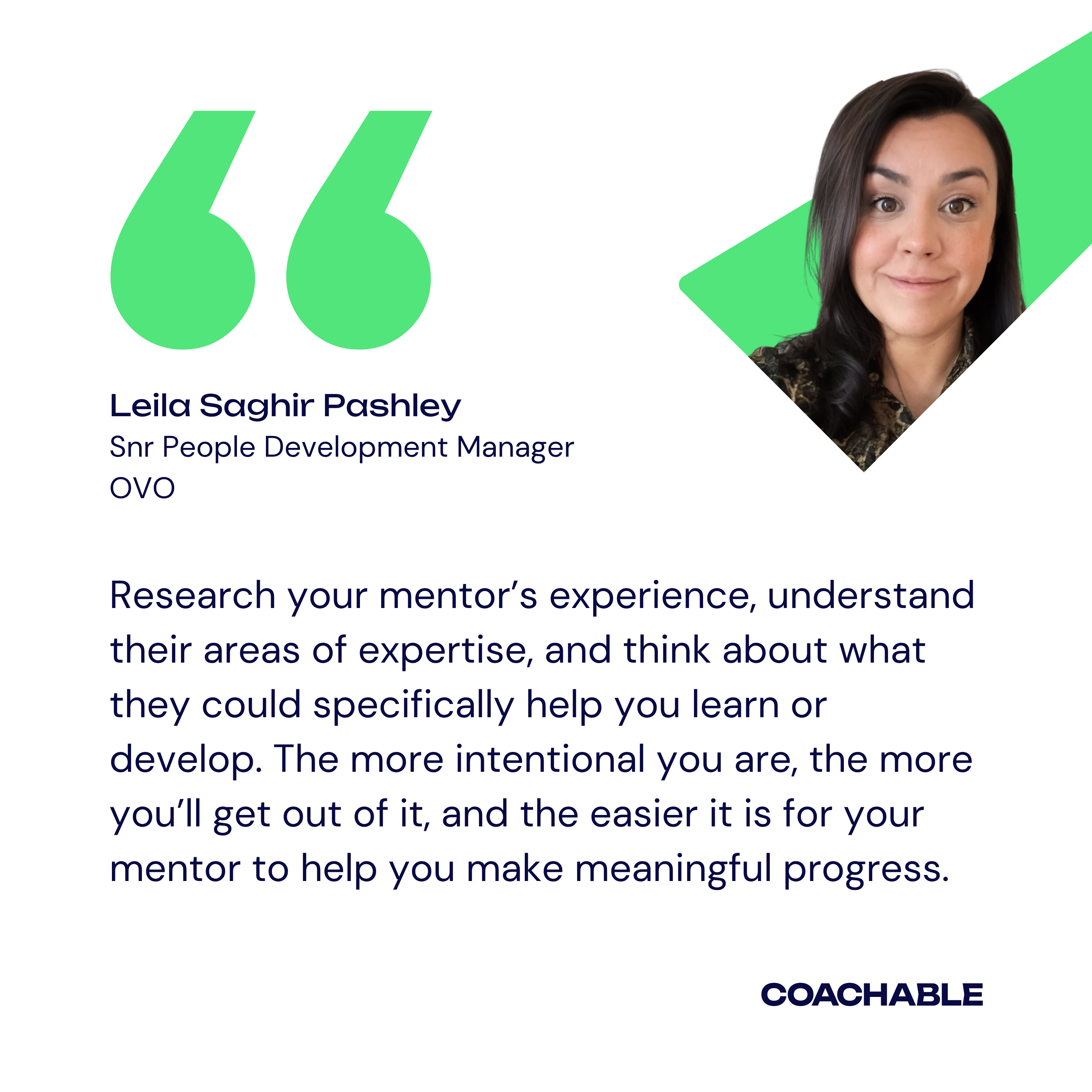
The theme around being prepared continued through most the responses, including this piece of feedback from OVO's Senior People Development Manager, Leila Saghir-Pashley:
03. Mentors can give you some cracking advice; listen to it What's the best piece of advice a mentor has ever given you?
We asked our community "what's the best piece of advice a mentor has ever given you?" and we loved the responses. We couldn't whittle these down to just a few, so we've selected our top 5 (plus a bonus one, but top 6 doesn't sound quite as punchy!):
Louise Gutteridge, Head of People and Culture, Barker Langham: A mentor once told me I had potential. It wasn't feedback on my performance, but belief in what I could become. Every other conversation had been an evaluation of the past. This one opened up the future, and it gave me the confidence to aim higher. Now I make a point of telling people when I see their potential, because I know how much it matters.
Laura Hounsome, Director : At a crossroads in my career, I was being encouraged to move into an executive leadership role. But when I looked around, I struggled to see leaders like me. Many of the examples I saw were men with quite a directive style. I was a people-focused leader, and I couldn't picture myself fitting that mould. My mentor challenged the assumption underneath that: why did I think I had to change who I was to become an executive leader? It completely changed my perspective. Perhaps I was being encouraged to take that step precisely because of who I was and how I led. I didn't have to become someone else to progress.
Andreea Constantin, Senior Leadership & Talent Consultant, Dante International: "You decide!" It was a piece of advice that functioned almost as a saying, or sometimes a punchline. We were a team of junior trainers and our mentor always responded with it when we were at a standstill. It took us a lot of time to understand that decisions really were ours to make, and to appreciate the advice and empowerment that came with it.
Jo Ionescu, Senior Experience Designer: A mentor once told me, "You don't have to know everything before you start." That really stuck with me. I used to put a lot of pressure on myself to feel fully prepared before taking on something new, but I learned that asking questions, making mistakes, and learning as you go is often how you become better at what you do.
Anabela Barbosa, Head of Talent Development, Feedzai: You don't have to know everything before you take on something new. I've come to realise that waiting until I felt completely ready meant missing opportunities that would help me grow.
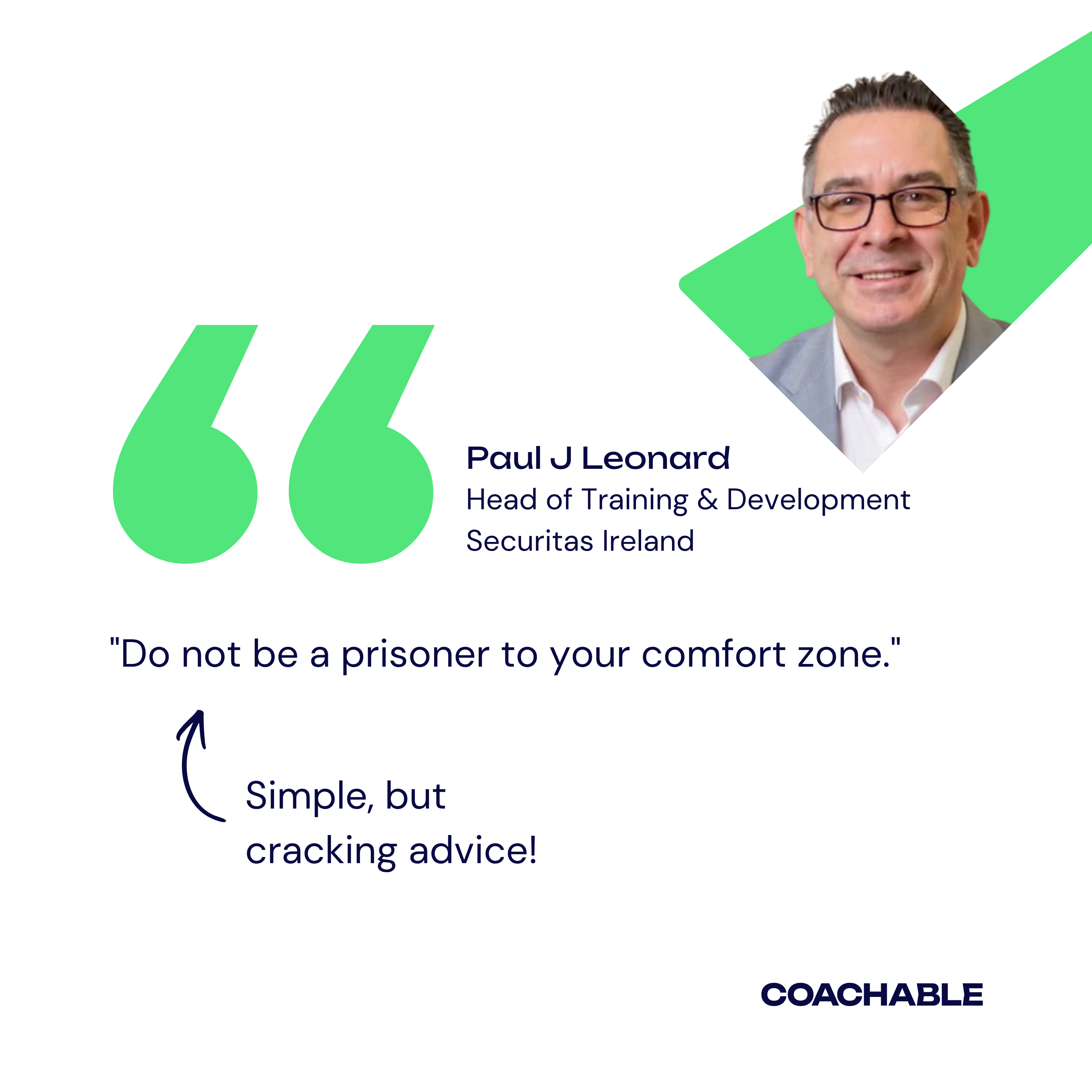
And possibly our favourite from Securitas Ireland's Head of Training & Development, Paul J Leonard: "Do not be a prisoner to your comfort zone".
04. The best questions to ask as a mentor
We asked "what's the best question a mentor has ever asked you?" and like before, we struggled to pick just a few. It was tough going, but here's our top 10 (in no particular order)
- "What do you need to be at your best? Because the world needs you at your best." - Louise Gutteridge, Head of People and Culture, Barker Langham
- "What would you do if you weren't afraid of getting it wrong?" - Anabela Barbosa, Head of Talent Development, Feedzai
- "What's stopping you from believing that you are already capable?" - Naila Shabeer, Co-Founder
- "What conversation are you not having that you need to have?" - Alan Bennett, Senior Programme Manager, The Scouts
- "What would you do if you faced no restrictions?" Followed by "What is holding you back?" - Paul J Leonard, Head of Training & Development, Securitas Ireland
- "What would YOU want to happen?" - Andreea Constantin, Senior Leadership & Talent Consultant, Dante International
- "What would happen if you stopped doing [X]?" - Lavinia Mehedintu, Co-Founder of Offbeat & Author of L&D Rewired
- "What would you do if you weren’t afraid of getting it wrong?" - Rizwana Mujeeb, Head of Human Resources, IFFCO
- "If you had an opportunity to revisit your life's choices, what it would it look like and what would change for you?" - Rampriya Sridharan, Workplace Culture Transformation Consultant
- "Are you making this decision because it's what you really want, or because it's what you think you should do?" - Jo Ionescu, Senior Experience Designer
05. Your mentoring culture comes from the top (no surprises)
This was the question we were keenest to hear about: How do you really build a mentoring culture? The answer is somewhat simple, and isn't too different to our advice on how to build a coaching culture. From the responses, there were three general themes that came through:
Culture starts at the top
People take their cue from what senior leaders do. When leaders make time to mentor, ask for help themselves and admit what they don't know, everyone else gets permission to do the same. When they don't, no programme will make up for it. Laura Hounsomes ays that "it starts with what leaders role model. If you make time to mentor, coach and guide people, you show that developing others is part of leadership. If you never make time for it, people will take their cue from that too."
It doesn't have to be formal
Several people told us the mentoring that mattered happened outside a scheduled session:
Anabela Barbosa, Head of Talent Development at Feedzai: Some of the most valuable mentoring happens outside formal mentoring relationships.
Paul J Leonard, Head of Training & Development, Securitas Ireland: Mentoring is a well; blended mix of formal and informal. A meeting in a corridor was one of the best experiences I shared with a mentor. Having had formal table top meeting we chatted without barriers inn an informal manner and wisdom was shared
Mentoring doesn't have to be top down
Mentoring can flow in every direction, from junior colleagues to senior leaders as well as the other way round, and between peers across teams:
Jo Ionescu, Senior Experience Designer: People should feel comfortable asking questions, sharing mistakes, and learning from each other, regardless of their role or seniority. Leaders can set the tone by being open about what they don't know, too. When learning goes both ways, mentoring becomes a natural part of how a team grows.
Louise Gutteridge, Head of People and Culture, Barker Langham: Mix it up! Reverse mentoring, where junior colleagues mentor senior leaders on areas like technology, AI and culture, breaks down hierarchy and generational stereotypes. It also shows that learning flows in every direction. The keys are visible leadership commitment, a clear purpose for each pairing, and enough psychological safety for junior mentors to speak candidly.
And finally - incase you needed a gentle prod to get going, some words of wisdom from Lavinia Mehedintu "Don't overcomplicate things... Just reach out to people you know who might want to become mentors, have a clear incentive structure, and a good comms plan, and things will happen naturally."
Reading through every answer, one thing stood out. The mentors people remember listened well, asked good questions and helped them think for themselves. In other words, they used coaching skills. That's the link between mentoring and coaching that we think gets missed. The best mentors know when to share their experience and when to step back and ask. And that's a skill you can build in your leaders (and it goes without saying, that's something we can help you with!) A huge thank you to everyone who shared their tips with us!
What other tips do you have? We'd love to hear them. Drop us a message at hello@wearecoachable.com or you can share your thoughts here.