CALMER Framework: Coaching for Resilience
Strengthen your Resilience Conversations with CALMER
Want your leaders to facilitate better conversations with their team about their resilience? We’re sharing our CALMER framework, adapted from The British Red Cross C.A.L.M.E.R framework.
We also recommend reading our blogs on how to build your own resilience (perfect for leaders) and how leaders can support their team with their resilience.
If you ask most leaders whether they check in with their people, they'll say yes. But checking in and actually getting under the surface of how someone is doing are two very different things. Most leaders aren’t particularly comfortable with the latter, meaning conversations stay surface level and never get to the nitty-gritty of what’s really going on for them. A lot of that comes down to not knowing what to say when the answer to “how’re you doing?” is "not great."
Where CALMER comes from
The C.A.L.M.E.R framework was originally developed by the British Red Cross as a psychosocial support approach to help people provide effective emotional support in high-stakes situations (emergency response, crisis support and humanitarian work). The fact that it was built and tested in some of the hardest experiences imaginable means we take comfort in the fact that if this can work in crisis situations, it can work well in an organisational context too.
The original framework stands for:
- Consider: Think about your own physical and mental health needs, as well as those of people closest to you.
- Acknowledge: Identify the source of the stress and recognize how it is physically and mentally impacting you.
- Listen: Pay close attention to how you are feeling without judgment; it is completely reasonable to feel frustrated or anxious during challenging times.
- Manage: Take practical steps to regain control over your environment, such as limiting social media scrolling, taking regular breaks, and setting boundaries.
- Enable: Think about what has helped you cope with difficult situations or stress in the past, such as exercising, hobbies, or connecting with friends.
- Resource: Identify what tools, people, or support systems you need to put these coping steps into action.
We've adapted their C.A.L.M.E.R framework to reflect the type of conversations leaders need to have around resilience. Naturally, being coaching advocates, it heavily relies on a coaching approach.
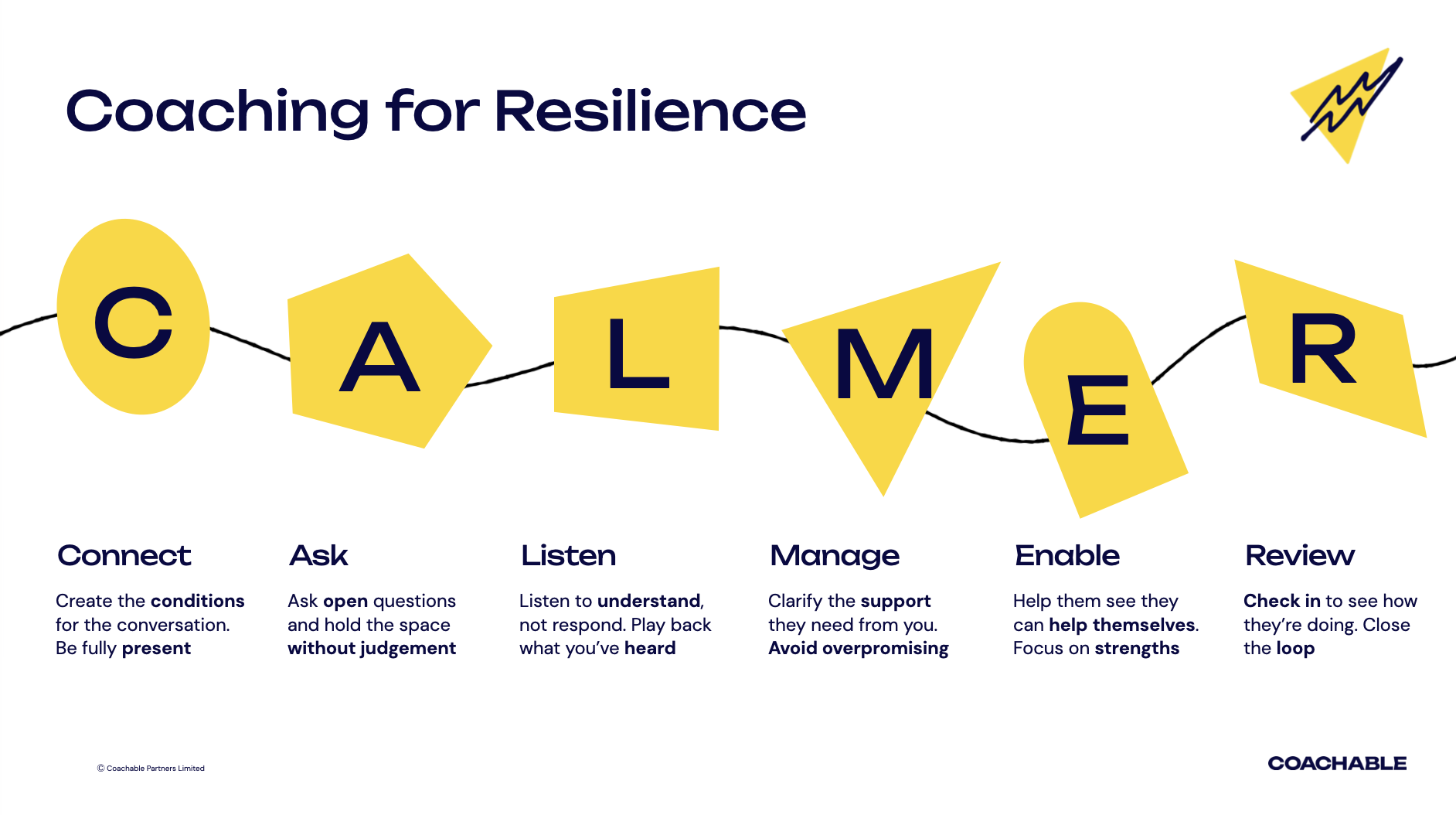
Connect
This is your opportunity to create the right conditions for a meaningful conversation. That means choosing the right moment, the right setting and being genuinely present. Where and when the conversation should take place will be dependent on the individual’s needs and your current capacity; if you’re feeling overwhelmed yourself, be mindful of how this’ll impact your attention and empathy during the conversation.
Ask
Asking open questions will help you to better understand their experience, and what’s important to them, both in terms of how they’ll manage their resilience and what support they need from you. Remember - your job isn’t to diagnose, to offer solutions or “fix” them but to create a thinking space for them to work through their thoughts.
Avoid offering a solution packaged as a question e.g. “Have you thought about trying…” and asking questions that start with why e.g. "Why didn't you speak to me about this earlier?" as it risks being perceived as judgemental.

Listen
This is harder than it sounds and most of us listen to respond. This is especially true when the topic of conversation makes us uncomfortable; you might be thinking about what you can or can’t say, or simply not knowing what to say at all. The goal here is to listen to understand and to demonstrate that you’ve done that. Playing back what you've heard shows you've taken it in, and it gives the person the chance to correct you if you've misheard something.
Listening without rushing to fix is one of the most powerful things you can do for someone.
Manage
This is where you clarify what kind of support they're actually asking for. It might be that they want practical help, signposting to your EAP or internal resources, or simply want to vent and feel heard. Equally, some might want you to back off a little and give them space! You won't know unless you ask.
To help understand what support they need from you, questions like "What would be most useful from me right now?" can be a simple, but effective question to ask.
Enable
Remember: your job isn't to fix things for them, but to help them see what they're already capable of and to reconnect them with their own resources. Help them reflect on when they’ve been through similar challenges in the past, how they can better lean on their strengths and what tools or people would be helpful for them to utilise.
Questions like "When have you navigated something like this before? What helped you then?" or "What would you do if you trusted yourself more in this situation?" can help build the person's confidence in their own judgement and prevent creating reliance on yours.
Review
Always make sure to follow up; not only does it show them you care, but it helps to keep them to stay accountable. That can be a simple “How are things?” or “Last week you mentioned you wanted to try X. How’s that going?”
We deep dive into the CALMER framework in much more depth in our Resilience workshops and help leaders to adopt a coaching mindset when having uncomfortable conversations with their teams. We explore how to build resilience without creating dependencies, and how leaders can protect their own boundaries whilst encouraging others to do the same. If you’d like us to support your leaders to build resilient teams, get in touch at hello@wearecoachable.com or book in a call.